







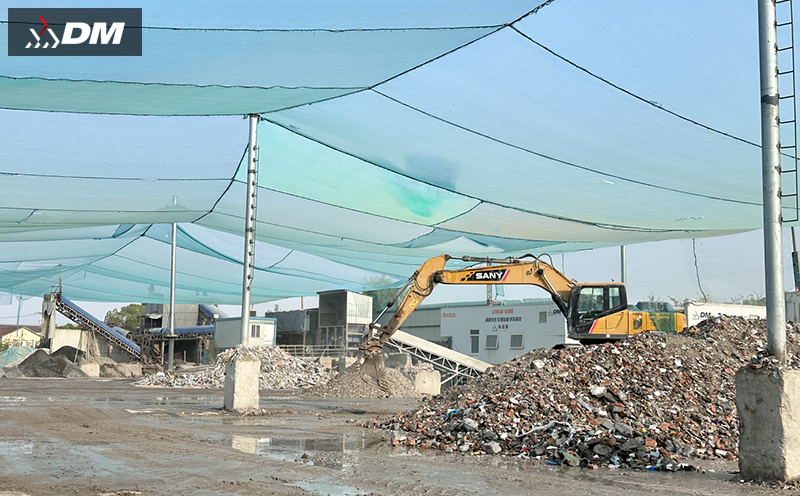
New Zealand's construction industry is accelerating its transition to a "circular economy." The Resource Management Act (RMA) and construction waste management regulations have set clear requirements for on-site waste reduction and resource recycling rates, making "zero-waste building sites" a core goal of industry development. From urban renewal projects in Auckland to resort construction in Queenstown, the efficient recycling and reuse of construction waste is not only a compliance prerequisite but also a key to reducing project costs and fulfilling environmental responsibilities. Focusing on the needs of the New Zealand market, Shanghai Dongmeng has developed an advanced recycling solution for construction waste integrating "intelligent sorting, efficient conversion, and environmental protection." It converts waste such as concrete blocks, bricks, and steel bars into high-quality recycled building materials, helping local areas achieve resource circulation and zero-waste goals in the construction industry, and injecting new momentum into sustainable construction.
I. Intelligent Sorting Technology: Precise Separation to Ensure Recycling Quality
New Zealand's construction waste has complex components, and strict requirements for the purity of recycled building materials. Shanghai Dongmeng's advanced recycling system achieves precise classification and efficient impurity removal of waste through multi-dimensional sorting technology.
- Multi-Module Collaborative Sorting: Integrates vibrating screening, intelligent magnetic separation, air separation, and manual auxiliary sorting modules. Sensors identify differences in material density, magnetism, and particle size, automatically separating magnetic metals such as steel bars and iron nails (recovery rate ≥99%), and screening out light impurities such as wood, plastic, and fabrics. This ensures the purity of recycled aggregates reaches over 98%, fully meeting New Zealand's recycled aggregate standard (NZS 4419);
- Adaptive Material Adjustment: The system can automatically adjust sorting parameters according to the type of construction waste (demolition waste, decoration waste, road reconstruction waste, etc.) without frequent manual intervention, adapting to diverse construction site scenarios. The sorting efficiency is 30% higher than that of traditional equipment;
- Visual Operation Interface: Equipped with a Chinese-English bilingual control system, the sorting process is monitored in real time, and the impurity separation effect is displayed intuitively. Operators can master it proficiently after simple training, lowering the usage threshold.
II. Efficient Conversion Process: Producing High-Value Recycled Building Materials
Targeting the diversified needs of recycled building materials in New Zealand's construction industry, Shanghai Dongmeng's recycling system adopts optimized crushing and shaping processes to achieve high-value conversion of waste.
- Graded Crushing + Shaping Technology: Adopts a three-stage processing flow of "coarse crushing + fine crushing + shaping," combined with jaw crushers, impact crushers, and vertical shaft impact crushers. It performs step-by-step crushing and particle shape optimization on sorted hard materials. The recycled aggregates have regular particle shape and continuous gradation, with the content of needle-like and flake-like particles <5%, which can be directly used in key scenarios such as concrete mixing, road base paving, and foundation backfilling;
- Flexible Production of Diversified Products: According to project requirements, it can produce recycled aggregates of different specifications (5-31.5mm) and recycled manufactured sand (0-5mm). It can also be further processed into finished building materials such as recycled permeable bricks and recycled concrete precast blocks, extending the industrial chain value and adapting to diverse application scenarios such as residential construction, municipal engineering, and landscape greening;
- Low-Consumption and High-Efficiency Operation: Equipped with high-efficiency energy-saving motors and intelligent load regulation systems, the power consumption per unit capacity is 20%-25% lower than that of traditional equipment; the crushing chamber adopts a fully sealed design, combined with pulse dust removal and spray dust suppression devices, the dust emission concentration is <5mg/m³, and the noise is controlled below 75dB, meeting New Zealand's on-site environmental emission standards.
III. Flexible Adaptation Design: Meeting New Zealand's Construction Site Scenarios
Combined with the characteristics of scattered construction sites, limited space, and strict environmental requirements in New Zealand, Shanghai Dongmeng's recycling system has been targeted optimized in equipment layout and operation mode to improve scenario adaptability.
- Mobile and Convenient Deployment: Adopts track-mounted or tire-mounted mobile design, which can be quickly transported to different construction sites by flatbed trailers. Track-mounted equipment can be directly stationed in remote construction sites or operation points with complex terrain, without the need for large-scale site leveling, reducing on-site disturbance;
- Integrated Design: Integrates the entire process of "feeding - sorting - crushing - screening - finished product storage." A single equipment can complete the entire conversion from waste to recycled building materials without additional auxiliary equipment, saving site space and equipment investment;
- Strong Environmental Adaptability: The electrical system adopts IP66 dustproof and waterproof design, and core components are equipped with corrosion-resistant coatings, which can operate stably in New Zealand's rainy and high-humidity environment; the equipment body adopts a sound insulation and noise reduction structure, adapting to construction site scenarios sensitive to noise such as urban centers and residential areas.
IV. Dual Economic and Environmental Value: Supporting Circular Economy Development
Shanghai Dongmeng's advanced recycling solution for construction waste not only creates significant economic benefits for New Zealand's construction enterprises but also promotes the industry to achieve environmental responsibilities and sustainable development goals.
- Reduce Project Costs: The production cost of recycled building materials is only 60%-70% of that of natural building materials, significantly reducing raw material procurement costs; at the same time, it reduces the transportation and landfilling costs of construction waste (landfilling costs in New Zealand are relatively high), creating dual economic benefits for enterprises;
- Reduce Environmental Pressure: Processing 10,000 tons of construction waste can save about 6,000 tons of natural aggregate mining and reduce the occupation of about 3,000 cubic meters of landfill space, reducing dependence on natural mines and land resources and protecting the ecological environment;
- Align with Policy Orientation: Helps construction enterprises meet New Zealand's "Circular Economy Strategy" and construction waste reduction goals, enhances corporate environmental image, strengthens project bidding competitiveness, and promotes the industry's transformation towards green and low-carbon development.
Conclusion
In the wave of New Zealand's "zero-waste" and circular economy development, the efficient recycling and reuse of construction waste has become an inevitable choice for the high-quality development of the construction industry. With core advantages of intelligent sorting to ensure quality, efficient conversion to enhance value, and flexible design to adapt to scenarios, Shanghai Dongmeng's advanced recycling solution provides a practical path for New Zealand's construction enterprises to achieve zero-waste building sites, transforming construction waste from an "environmental burden" into a "circular resource."
In the future, Shanghai Dongmeng will continue to focus on the environmental and technical needs of the New Zealand market, continuously optimize product performance and process design. With more advanced technologies and more reliable equipment, we will help local construction enterprises break through resource constraints, achieve a win-win situation between economic development and ecological protection, and jointly build a sustainable circular construction ecosystem!
If you would like to get help immediately, you can also fill your requirements on the following form, we will contact you on the right time.


Get In Touch