







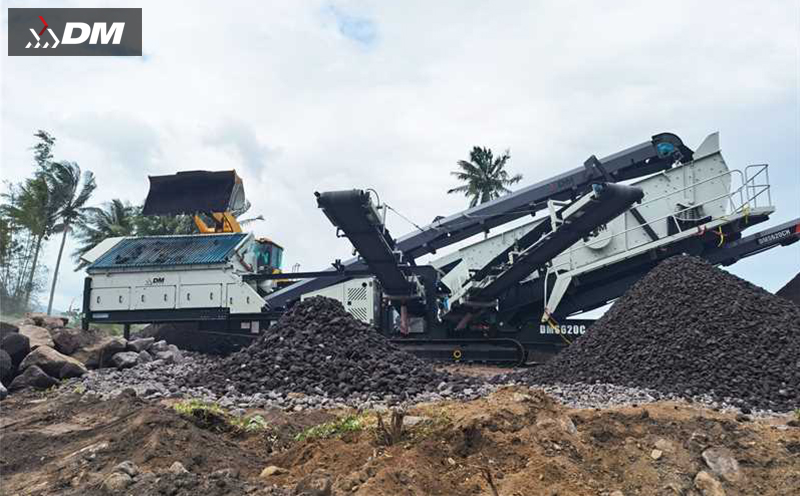
I. The "Wear Trap" of New Zealand's West Coast: An Invisible Killer of Mining Operations
New Zealand's West Coast is renowned for its abundant gold and copper resources, but its geological and environmental conditions are tantamount to the "ultimate wear test" for crushers: Mining areas are mostly distributed in the foothills of the Southern Alps, with ores dominated by hard porphyry containing quartz, which has a Mohs hardness of 7-8. The wear intensity on crushing chamber liners is 3 times that of ordinary ores; the temperate maritime climate brings annual rainfall of over 2,000 millimeters, resulting in ore moisture content often exceeding 15%, which easily causes equipment blockage and component corrosion; some mining areas also have large amounts of weathered rock formations containing silica sand, whose fine particles accelerate the abrasion of bearings and hydraulic systems.
Traditional crushers struggle in such working conditions: A gold mine project once required liner replacement every 15 days on average, leading to over 80 hours of monthly downtime for maintenance; another copper mine project suffered from hydraulic system abrasion and leakage, with monthly maintenance costs exceeding NZ$180,000 and mining progress lagging by 30%. The industry consensus has been formed: On the West Coast, the "wear resistance" of crushers directly determines the continuity and profitability of mining operations.
II. Core Breakthroughs: Custom "Wear-Resistant + Stable" Design for High-Wear Conditions
Our mine crushers, custom-built for New Zealand's West Coast, take "extreme wear resistance + intelligent stability" as dual cores. Through five key technological innovations, they fundamentally reduce wear losses and improve operational reliability. Their core advantages are concentrated in three systems:
1. Ultra-Wear-Resistant Crushing System: Extending Wear Part Life by Over 50%
Targeting the wear pain points of hard ores, the crushing chamber adopts a "gradient wear-resistant structure" design: Liners are made of independently developed high-chromium alloy material, which reaches HRC65 hardness after high-temperature quenching, with tungsten carbide wear-resistant blocks inlaid on the surface. Its impact wear resistance is 2 times higher than that of ordinary high-manganese steel; the feed inlet is equipped with an adjustable anti-blocking grille and a high-frequency vibrating feeder, which can pre-separate large impurities and wet-sticky ores, avoiding "hard impact" and "adhesive blockage" that exacerbate wear. In field tests at a gold mine on the West Coast, the equipment's liner service life was extended to 45 days, the replacement frequency of wear parts was reduced by 67%, and the wear cost per ton of ore dropped from NZ$12 to NZ$5.
2. Sealing and Protection System: Isolating Moisture and Dust Erosion
To cope with the high-humidity and dusty environment, the equipment adopts "triple sealing + pressure balance" technology: The rotating shaft end is equipped with a combined structure of lip seal + labyrinth seal + dust retaining ring, reaching IP68 protection level, which can effectively block silica dust and rainwater intrusion; the hydraulic system adopts an integrated oil circuit design, reducing exposed pipelines by 90%, with all interfaces connected by tapered seals, resulting in a leakage rate of less than 0.1%; the electrical control cabinet has a built-in constant temperature dehumidifier, which automatically starts when humidity exceeds 60% to prevent circuit short circuits due to condensation. At the rainy Greymouth mining area, the equipment operated continuously for 3 months in the rain with zero failures in hydraulic and electrical components, achieving a qualitative breakthrough compared to the 12 failure records of traditional equipment.
3. Intelligent Maintenance System: Predicting Failures to Reduce Unplanned Downtime
The equipment is equipped with multi-dimensional sensors and IoT terminals, which can real-time collect 16 key parameters such as liner wear, bearing temperature, and hydraulic oil contamination. Cloud algorithms generate "wear trend curves" and "fault warning reports". When liner wear approaches the critical value, the system sends replacement reminders 72 hours in advance; when bearing temperature rises abnormally, it automatically activates forced heat dissipation and reduces load operation to avoid "thermal failure" triggering chain faults. Data shows that the intelligent system achieves a 90% predictive maintenance rate for the equipment, reducing unplanned downtime from 40 hours per month to 8 hours, and increasing effective operating time by 25%.
III. Practical Verification: "Ultra-High Availability Revolution" in West Coast Mining Areas
In the second half of 2023, a large copper mine project on the West Coast introduced 8 units of this custom crusher. After replacing the original traditional equipment, the mining operation efficiency and cost control achieved subversive improvements, with key data as follows:
- The average equipment availability increased from 75% to 93%, the monthly average effective crushing time rose from 480 hours to 670 hours, and copper ore processing capacity increased by 40%;
- The monthly average procurement cost of wear parts decreased from NZ$1.2 million to NZ$450,000, and maintenance labor costs were reduced by 58%;
- Lost work costs caused by wear failures dropped from NZ$950,000 to zero, and the crushing cost per ton of copper ore decreased from NZ$38 to NZ$22;
- The project's mining progress was 15 days ahead of schedule, with additional output value exceeding NZ$5 million.
The project's mining director stated: "Mining on the West Coast is not easy, and the key is that equipment 'can't hold up'. This set of crushers can not only 'crush' hard ores but also withstand rain and dust. With availability up, we truly have the confidence for mining."
IV. Adaptation and Maintenance Guide for West Coast Mining Areas
Combined with the working condition differences of different mining areas on the West Coast, maximizing equipment value requires proper selection and maintenance planning:
1. Working Condition-Adapted Selection Recommendations
- High-hardness gold/copper mines (e.g., around Hokitika): Prioritize jaw + cone combined crushing models to enhance wear resistance in primary and secondary crushing links;
- High-humidity clay-containing mining areas (e.g., Greymouth): Select mobile crushing plants with drying functions, paired with anti-blocking feeding systems to avoid caking and wear of wet-sticky ores;
- Remote high-altitude mining areas (e.g., near Arthur's Pass): Choose hybrid diesel-electric dual-power models to adapt to scenarios without stable power supply, and equip with plateau heat dissipation modules.
2. Localized Maintenance Tips
- Establish a wear database: Record the correspondence between ore hardness, moisture content, and wear part life in different mining sections to formulate personalized replacement plans;
- Rainy season special protection: Inspect the integrity of seals monthly, apply waterproof sealant to exposed hydraulic interfaces, and replace dehumidifying desiccants in electrical cabinets regularly;
- Intelligent system linkage: Arrange dedicated personnel to monitor cloud data in real time, ensuring response to warning information within 15 minutes to achieve "early fault detection and early maintenance intervention".
Conclusion
New Zealand's West Coast has huge mineral resource potential, but high-wear working conditions have long been a "shackle" restricting development efficiency. Our custom mine crushers resist hard ore erosion with ultra-wear-resistant crushing systems, isolate moisture and dust with precision sealing protection, and predict potential faults with intelligent maintenance systems, transforming "wear losses" into "stable production capacity". At gold mines in Hokitika and copper mines in Greymouth, this set of equipment is proving with over 93% ultra-high availability that conquering the high-wear challenges of the West Coast does not require compromise between "production capacity" and "equipment life". Choosing a crusher adapted to working conditions can turn the West Coast's "wear trap" into a "resource-rich mine", injecting strong momentum for sustained profitability into mining enterprises.
If you would like to get help immediately, you can also fill your requirements on the following form, we will contact you on the right time.


Get In Touch