







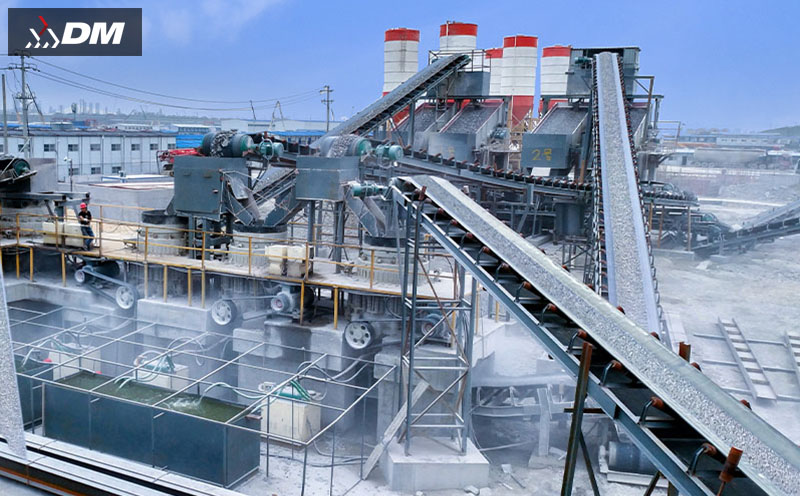
New Zealand, with its steady infrastructure planning (road upgrades, affordable housing construction, port expansions) and abundant mineral resources (South Island gold mines, North Island limestone mines, geothermal-related minerals), has become a core demand market for crushing equipment. However, the local market presents distinct characteristics of "high requirements and diversification": globally leading environmental policies (the Resource Management Act imposes strict limits on dust, noise, and wastewater emissions), scattered project scenarios (from remote mining sites in the South Island to suburban infrastructure projects in Auckland), significant differences in raw material characteristics (high-hardness gold ore, uneven mud content in limestone, complex composition of construction waste), coupled with high labor costs and strict site approval processes. Traditional fixed crushing production lines face the triple dilemma of "failure to meet environmental standards, insufficient adaptability, and high operating costs," making it difficult to satisfy New Zealand clients' core demands for "efficiency, compliance, and sustainability."
With "scientific process planning as the core, modular customization as the support, and environmental protection and automation as the guarantee," the modular crushing system accurately matches New Zealand's market needs. Through a full-dimensional solution of "raw material adaptation, standard compliance, cost optimization, and long-term adaptability," it creates a maximum benefit crushing system for local mineral development, infrastructure construction, building materials production and other scenarios, becoming the preferred equipment for New Zealand clients.
I. Scientific Process Planning: Achieving Dual Compliance of Efficiency and Standards Based on Raw Materials
The core competitiveness of the modular crushing system stems from "tailor-made" scientific process planning. The engineering team deeply integrates New Zealand's raw material characteristics and industry standards to build a fully optimized crushing system:
- Precise raw material adaptation: For common raw material types in New Zealand — South Island gold ore (Mohs hardness 7-8), North Island limestone (mud content 3%-8%), and construction demolition waste (mixed materials of bricks and concrete) — key parameters such as particle size distribution, humidity, and wear resistance are analyzed one by one to customize exclusive crushing processes. For example, when processing high-hardness gold ore, the wear resistance and crushing chamber design of the primary crushing module are enhanced; when processing high-mud-content limestone, pre-screening and sand washing links are added to avoid blockages affecting efficiency;
- Strict compliance with standards: All process designs comply with New Zealand's construction industry standards (NZS 3101 Concrete Structures Standard, NZS 4404 Aggregate Standard) and environmental regulations (dust emission limit ≤15mg/m³, noise limit ≤70dB), ensuring dual compliance of finished product quality and production processes. No additional rectification is required to pass local environmental and engineering acceptance;
- Extreme efficiency optimization: Through process layout simulation and equipment collaborative commissioning, seamless connection of capacity in all links (primary crushing - secondary crushing - tertiary crushing - screening - dust removal) is achieved, avoiding resource waste caused by "front-end congestion and back-end idleness." Combined with automatic control, per capita production efficiency is increased by more than 30% compared with traditional equipment, Overall Equipment Efficiency (OEE) is stably maintained above 88%, and unit product energy consumption is reduced by 18%, maximizing the compression of operating costs.
II. Modular Customization: Flexibly Adapting to Multi-Scenes and Solving New Zealand's Market Pain Points
Targeting the characteristics of "scattered scenarios, changing demands, and limited sites" of New Zealand's projects, the modular crushing system adopts a "on-demand combination and free matching" customization model, allowing one set of equipment to adapt to multi-scene needs:
- Free module combination: Core units (feeding, crushing, screening, conveying, dust removal, power modules) are all standardized designs, which can be flexibly matched according to project needs. Small mining sites can be configured with "jaw primary crushing module + simple screening + diesel power" to meet the small capacity demand of 30-80 tons per hour; large infrastructure projects can be combined with "jaw primary crushing + cone secondary crushing + impact tertiary crushing + three-layer screening + fully enclosed dust removal" to achieve large-scale production of 200-500 tons per hour; construction waste recycling projects can add "intelligent sorting module + shredding module" to separate recyclable resources such as metals and plastics, improving resource utilization rate;
- Strong site adaptability: The modular design does not require complex foundation construction. Equipment can be disassembled and transported to narrow sites (such as Auckland urban demolition sites) or remote mining sites (South Island mountain gold mines), and quickly assembled and commissioned on-site, significantly reducing site approval and infrastructure costs. For temporary projects, "dismantling and relocation upon project completion" can be achieved, avoiding equipment idleness and site occupation;
- Precise product customization: By replacing crushing modules and adjusting screen specifications, the finished product particle size can be precisely controlled between 0-5mm high-quality manufactured sand, 5-10mm fine aggregates, 10-30mm coarse aggregates, and 30-40mm extra-coarse aggregates, meeting different engineering needs such as road subgrade, concrete pouring, and wall plastering without additional purchase of special equipment.
III. Automation + Environmental Protection: Aligning with New Zealand's "Efficient and Low-Carbon" Development Concept
As a benchmark country for low-carbon economy, New Zealand has extremely high requirements for "efficiency, energy saving, and environmental protection" in the production process. The modular crushing system achieves dual breakthroughs through technological upgrades:
- Automation reduces costs and manpower: Equipped with a PLC centralized control system, operators can complete full-line start-stop, parameter adjustment, equipment monitoring, and fault early warning in the control room. Only 1-2 personnel are required for a single production line to complete the full-process operation, significantly reducing New Zealand's high labor costs (saving 65% of manpower input compared with traditional manual models). At the same time, the system supports remote diagnosis and data statistics, reducing on-site maintenance frequency and lowering the operation and maintenance difficulty of remote projects;
- Environmental closed-loop design: Adopting fully enclosed corridors + pulse bag filter systems, the dust emission concentration is controlled below 10mg/m³, far lower than New Zealand's environmental limits; the equipment is equipped with sound insulation covers and shock absorption pads, reducing operating noise to within 65dB, avoiding impact on surrounding residential areas or nature reserves (such as projects around New Zealand's national parks); all wastewater is recycled after sedimentation and filtration (such as equipment cooling and site cleaning), realizing zero discharge of water resources and aligning with local "water resource protection" policies;
- Energy-saving and low-carbon operation: Core equipment adopts energy-saving motors and optimized crushing chamber design, reducing unit capacity energy consumption by 18% compared with traditional equipment; diesel power modules select Euro V emission standard engines, and exhaust emissions comply with New Zealand's clean air regulations, helping clients build a "green engineering" image.
IV. Strong Expandability + Localized Services: Protecting Long-Term Investment Value
At the initial design stage, the modular crushing system considers the long-term development needs of New Zealand clients, maximizing the extension of equipment life cycle and investment return cycle through "flexible capacity expansion + localized support":
- Convenient capacity expansion and upgrading: Standardized expansion interfaces are reserved. When future capacity increases or product type adjustments are needed, there is no need to rebuild the production line. Upgrades can be completed only by adding crushing modules, replacing screening machines, or adding auxiliary units (such as sand washing modules and intelligent sorting modules), reducing expansion costs by 70% compared with traditional fixed lines. For example, a small mining enterprise expanding from 50 tons per hour to 200 tons per hour only needs to add cone secondary crushing and impact tertiary crushing modules and link them with the original system;
- Localized service support: Cooperating with local maintenance enterprises in Auckland and Christchurch, New Zealand, core vulnerable parts (crushing jaws, screens, dust filter elements) are reserved to ensure that the spare parts supply cycle is shortened to within 48 hours; on-site installation, commissioning, operation training, and regular inspection services are provided to solve clients' concerns about "slow cross-border after-sales response;"
- Full life cycle support: Provide process optimization consulting services, and real-time optimize process parameters and module configurations according to changes in clients' raw materials (such as fluctuations in ore hardness at mining sites) or project demand adjustments (such as upgrades to finished product standards), ensuring that the equipment is always in optimal operating condition, and the investment return cycle is extended to 8-10 years.
V. Practical Case in New Zealand: Modular System Empowering South Island Gold Mines and Auckland Infrastructure
A New Zealand mining company operates a gold mining project in the Canterbury region of the South Island and undertakes an Auckland suburban road expansion project. After introducing a set of modular crushing system, it achieved efficient operation of "one equipment for two scenarios":
- Gold ore crushing scenario: Configured with "jaw primary crushing + cone secondary crushing + simple screening + diesel power" modules, processing gold ore with hardness 7 grade, with an hourly capacity of 120 tons. The crushed ore is directly supplied to the concentrator without secondary transportation. The comprehensive equipment utilization rate reaches 92%, saving 20% energy compared with traditional equipment;
- Road aggregate scenario: Switched to "jaw primary crushing + cone secondary crushing + impact tertiary crushing + three-layer screening + fully enclosed dust removal" modules, using gold mine tailings and local limestone to produce 10-30mm road base aggregates and 0-5mm manufactured sand, with an hourly capacity of 250 tons. The finished product quality meets NZS 4404 standards, directly supplying road projects, and reducing raw material procurement costs by 40%;
- Comprehensive benefits: During 12 months of project operation, the equipment was transferred twice (300 kilometers between the gold mine and the road construction site), and the transfer cost was only 30% of that of traditional equipment; labor costs were saved by 68%, all environmental testing items met standards, and it won the "Low-Carbon Production Demonstration Project" certification from New Zealand's Ministry for the Environment; the project investment return cycle was shortened to 2.8 years, 1.2 years earlier than expected.
The person in charge of the company said: "New Zealand's market has extremely high requirements for compliance and flexibility. The scientific process of the modular crushing system allows us to not worry about environmental protection and quality issues, while the modular design perfectly adapts to the dual needs of gold mining and infrastructure. Coupled with localized after-sales support, our operational efficiency has been greatly improved and costs have been significantly reduced."
Conclusion
Against the market environment of "environmental protection first, efficiency first, and diversified demands" in New Zealand, the modular crushing system completely breaks many limitations of traditional crushing equipment with its core advantages of "scientific process planning to achieve compliance and efficiency, modular customization to solve scenario constraints, automation and environmental protection to align with development concepts, and strong expandability to protect long-term value."
Whether it is mineral development in remote mountainous areas, construction waste recycling in urban areas, or aggregate supply for large-scale infrastructure, the modular crushing system can create comprehensive value of "minimum compliance costs, maximum operational efficiency, and longest investment return" for New Zealand clients through precise customization and efficient operation. It is not only a set of crushing equipment, but also a "benefit growth solution" to help New Zealand clients enhance their competitiveness in a stringent market environment, injecting efficient, low-carbon, and sustainable new momentum into local mineral development and infrastructure upgrading.
If you would like to get help immediately, you can also fill your requirements on the following form, we will contact you on the right time.


Get In Touch