







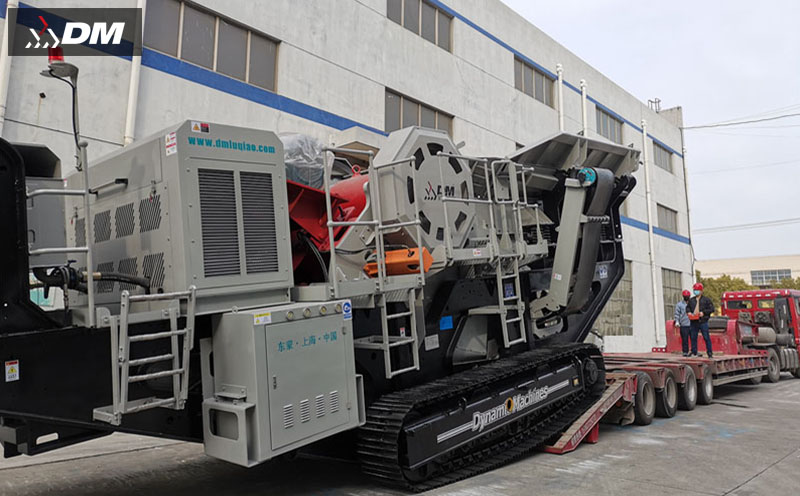
New Zealand's working conditions present distinct "variability" characteristics: the South Island is dominated by mountainous mining areas (gold mines, limestone mines) with rugged terrain and inconvenient transportation; North Island infrastructure sites (road upgrades, affordable housing construction) are scattered; urban demolition sites (Auckland, Christchurch) have narrow spaces. Additionally, the country has strict environmental policies, high labor costs, and flexible project cycles (short-term projects account for over 60%). Traditional fixed crushing equipment faces four major dilemmas: difficult transfer, slow commissioning, poor adaptability, and high compliance costs, failing to meet New Zealand clients' core demands for "flexible adaptation, rapid response, low-carbon efficiency."
With "intelligent remote control as the core, ready-to-use as the highlight, flexible adaptation as the support, and environmental compliance as the guarantee," the intelligent remote-controlled mobile crushing and screening plant accurately addresses the pain points of New Zealand's variable working conditions. Whether it is mountainous mining areas, remote infrastructure projects, or narrow urban sites, it can achieve "commissioning upon arrival, pressure-free transfer, low-manpower operation, and full compliance with emissions standards," becoming the preferred equipment for multi-scene crushing operations in New Zealand.
I. Core Advantage 1: Intelligent Remote Control, Low-Manpower and High Efficiency
Targeting New Zealand's high labor costs (about 2.5 times the global average) and shortage of professional operators, the equipment is equipped with an advanced intelligent remote control system, realizing efficient operation of "one person controlling the whole process":
- Remote precise control: Equipped with an industrial-grade wireless remote control terminal with a control distance of 100 meters. Operators can complete full-process operations such as equipment start-stop, adjustment of crushing parameters (discharge particle size, crushing frequency), switching of screening specifications, and walking/steering in a safe area, without the need to be in close contact with high-noise and high-dust areas;
- Intelligent monitoring and early warning: Integrates high-definition cameras and sensor systems to real-time transmit equipment operation data (load, oil temperature, fuel consumption, output) to the remote control terminal, and synchronously trigger fault warnings (such as belt deviation, insufficient lubricating oil). Operators can remotely diagnose simple faults, reducing on-site inspection time;
- Extreme manpower reduction and efficiency improvement: Only 1 person is required to complete the full-process operation of a single unit, saving 80% of labor costs compared with traditional manual operation models; combined with automatic feeding and intelligent screening control, the Overall Equipment Efficiency (OEE) is stably maintained above 88%, and per capita production efficiency is increased by 300%.
II. Core Advantage 2: Ready-to-Use, No Infrastructure Required
The equipment completely subverts the "infrastructure dependence" model of traditional fixed crushing lines, realizing a rapid closed loop of "transportation - deployment - commissioning," perfectly adapting to New Zealand's short-term project needs:
- No foundation construction required: Adopts a fully vehicle-mounted integrated design, integrating core modules such as feeding, crushing, screening, conveying, and dust removal onto a crawler or tire chassis. No concrete foundation pouring is needed; the equipment can be deployed only by simply leveling the site (1-2 hours) on-site, saving 95% of infrastructure time;
- Rapid commissioning and operation: After the equipment is transported to the site, oil circuit, circuit connection and parameter debugging can be completed in 2-4 hours, and production can start immediately. Compared with traditional fixed lines, the commissioning cycle is shortened by 90%, which is especially suitable for short-term projects of 3-12 months;
- Independent power supply without dependence: Equipped with a high-power diesel generator module (complying with Euro V emission standards) as standard, it can operate stably without connecting to the power grid, solving the problem of power shortage in remote mining areas of the South Island and realizing "high yield even without electricity;"
- Flexible transfer with zero loss: The crawler chassis has a climbing capacity of 35% and low ground pressure, enabling free travel on complex terrains such as mountains, mud, and gravel; the tire chassis has a transfer speed of 45km/h, making transfer more efficient for road-side projects in the North Island. The inter-project transfer cost is reduced by 70%, and the equipment loss rate is controlled within 5%, realizing "completion of one construction site and immediate departure to the next."
III. Core Advantage 3: Flexible Adaptation to New Zealand's Variable Working Conditions
Targeting New Zealand's characteristics of "variable terrain, complex raw materials, and scattered scenes," the equipment achieves full-scene precise adaptation through modular combination and structural optimization:
- Strong terrain adaptability: The crawler model adopts a triangular crawler design, which can stably travel on steep slopes (slope ≤30°) and muddy mining areas in the South Island; the tire model is equipped with off-road tires, suitable for infrastructure in the North Island plains and urban road transfer, with a global terrain coverage rate of 98%;
- Wide raw material adaptation: Can flexibly match jaw crusher (primary crushing), cone crusher (secondary crushing), and impact crusher (tertiary crushing/shaping) modules, adapting to raw materials of different hardness — gold ore (Mohs hardness 7-8), limestone (mud content 3%-8%), construction waste (mixed bricks and concrete), etc. The crushing efficiency is 25% higher than that of traditional mobile equipment;
- Flexible site adaptation: The equipment has a compact body (minimum turning radius ≤5 meters) and can enter narrow urban demolition sites in Auckland (width ≤8 meters) for operation; the modular design supports split transportation, which can be transported to remote island projects by small ships or helicopters, with no dead ends in scene adaptation.
IV. Core Advantage 4: Environmental Compliance, Meeting New Zealand's Strict Standards
The equipment strictly complies with the environmental requirements of New Zealand's Resource Management Act and Clean Air Act, creating a "zero-pollution" operation model to ensure full-process compliance:
- Extreme dust control: Adopts a factory-style fully enclosed hood + fully enclosed corridor + high-efficiency pulse bag filter system, reducing dust emission concentration by more than 95%, with actual emissions ≤8mg/m³, far below New Zealand's environmental limit (15mg/m³), and no visible dust in the workshop;
- Noise and vibration control: Core equipment is equipped with sound insulation covers and shock absorption pads, reducing operating noise by more than 50%, with measured noise ≤65dB (10 meters away from the equipment), meeting the requirements for operations around residential areas and nature reserves; the equipment base adopts a rubber shock absorption design, reducing vibration transmission rate by 80% to avoid affecting surrounding buildings and ecological environment;
- Zero wastewater discharge: A small leachate collection device is installed. A small amount of sewage generated during sorting and crushing is recycled for equipment cooling and site cleaning after sedimentation and filtration, with a water resource recycling rate of 100% and no external discharge, aligning with New Zealand's water resource protection policies.
V. Core Advantage 5: Local Adaptation, Ensuring Long-Term Stable Operation
Combined with the characteristics of the New Zealand market, the equipment has been specially optimized in terms of service, maintenance, and spare parts supply to relieve clients' worries:
- Localized spare parts supply: Establishes strategic cooperation with local maintenance enterprises in Auckland and Christchurch, reserves core vulnerable parts (crushing jaws, screens, dust filter elements), shortens the spare parts supply cycle to within 48 hours, and enables rapid replenishment for remote projects;
- Bilingual training and service: Provides Chinese-English operation manuals and video tutorials, and dispatches professional engineers to conduct on-site operation and maintenance training, ensuring that local employees can work independently within 1 week; supports remote technical support with a fault response time ≤2 hours;
- Customized capacity and products: The hourly capacity of a single unit ranges from 30 to 300 tons, which can be flexibly selected according to project scale; the finished product particle size can be precisely controlled between 0-5mm manufactured sand and 30-40mm coarse aggregates, meeting New Zealand's NZS 4404 aggregate standard and adapting to multi-scene needs such as infrastructure, building materials, and mineral processing.
VI. Practical Case in New Zealand: Intelligent Mobile Plant Empowering South Island Gold Mines and North Island Infrastructure
A New Zealand engineering company undertook a gold mining project in the Otago region of the South Island and a Waikato road upgrade project in the North Island (the two operation sites are 600 kilometers apart, with a project cycle of 6 months). It introduced 2 intelligent remote-controlled mobile crushing and screening plants (crawler-type + tire-type), realizing efficient operation of "one equipment for two scenes":
- South Island gold mine scene: The crawler-type model (equipped with jaw + cone crushing modules) processes gold ore with hardness 7 grade, with an hourly capacity of 150 tons. The crushed ore is directly supplied to the concentrator without secondary transportation, and the comprehensive utilization rate of the equipment in mountainous terrain reaches 92%;
- North Island road scene: The tire-type model (equipped with jaw + impact crushing + three-layer screening modules) uses gold mine tailings and local limestone to produce 10-30mm road base aggregates and 0-5mm manufactured sand, with an hourly capacity of 200 tons. The finished product quality meets NZS 4404 standards, directly supplying road projects, and reducing raw material procurement costs by 45%;
- Comprehensive benefits: The equipment transfer only takes 8 hours (including transportation), and the transfer cost is only 25% of that of traditional equipment; labor costs are saved by 75%, all environmental testing items meet standards, and it won the "Low-Carbon Operation Demonstration Equipment" certification from New Zealand's Ministry for the Environment; the project was completed 1 month ahead of schedule, and the investment return period was shortened to 2.5 years.
Conclusion
Against the market environment of "variable working conditions, strict environmental protection, and high labor costs" in New Zealand, the intelligent remote-controlled mobile crushing and screening plant completely breaks many pain points of traditional crushing equipment with its core advantages of "intelligent remote control reducing manpower, ready-to-use saving time, flexible adaptation breaking limitations, and environmental compliance meeting standards."
Whether it is mineral development in remote mountainous areas of the South Island, scattered infrastructure sites in the North Island, or narrow urban demolition sites, it can be precisely adapted and operate efficiently, becoming a "mobile high-yield tool" for New Zealand clients to cope with variable working conditions. It is not only a crushing equipment but also an important support for New Zealand to achieve "circular economy" and "low-carbon development," injecting flexible, efficient, and sustainable new momentum into local mineral development and infrastructure upgrading.
If you would like to get help immediately, you can also fill your requirements on the following form, we will contact you on the right time.


Get In Touch