







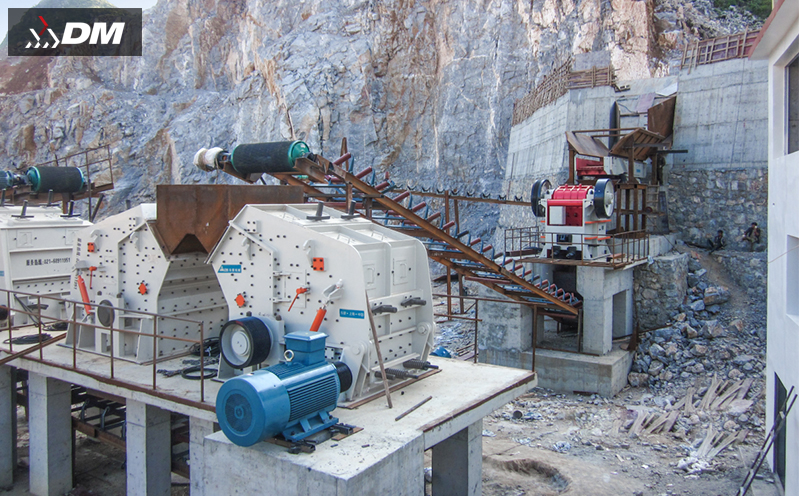
In industries such as mining, large-scale quarrying, and building materials processing, large fixed sites are the core carriers for achieving large-scale production and ensuring supply chain stability. Such sites generally face multiple challenges: long production cycles (usually 5-20 years), large processing scales (daily processing capacity from thousands to 10,000 tons), complex material characteristics, strict environmental requirements, and sensitivity to operation and maintenance costs. Traditional integrated fixed production lines have pain points such as "long design cycles, cumbersome installation and commissioning, difficulty in later transformation, and wide-ranging impacts of fault shutdowns", making it difficult to adapt to dynamic needs in long-term production such as capacity upgrades, material changes, and updates to environmental policies. Modular solutions, based on the core logic of "standardized units, flexible combination, rapid deployment, and on-demand upgrading", accurately match the long-term production demands of large fixed sites by splitting core functional modules and optimizing integrated design, becoming a key equipment system to support enterprises' sustained profitability, cost reduction, and efficiency improvement.
Modular Core Design: Adapting to Dynamic Needs of Long-Term Production
The core advantage of modular solutions lies in "unitized splitting and flexible recombination", which decomposes the complete production process into independent standardized modules such as crushing, screening, conveying, dust removal, and control. Each module has undergone industrial-grade verification, with unified interfaces and adaptability, and can be flexibly combined according to the site's material characteristics, capacity goals, and product specifications to form a dedicated production system.
Crushing modules cover full working condition needs: for high-strength materials such as granite and basalt, high-energy hydraulic cone crushing modules (secondary crushing) and vertical shaft impact crushing modules (tertiary crushing) are configured, adopting the principle of laminated crushing, with a large crushing ratio and uniform discharge, extending the service life of wear-resistant parts by 30%; for medium and low-hardness materials such as limestone and gypsum, high-efficiency impact crushing modules are matched, increasing crushing efficiency by 25% and reducing energy consumption by 18%; the primary crushing link uniformly adopts deep-cavity jaw crushing modules, with a feed opening width selectable from 800-1600mm, adapting to extra-large raw ores with a particle size ≤1200mm, laying the foundation for long-term continuous production. Screening modules support multi-stage configuration, and double-layer or three-layer high-frequency vibrating screen modules can be selected. The screen mesh aperture can be quickly replaced (3-31.5mm), enabling precise classification of finished products of different specifications with a screening efficiency of over 92%, meeting the needs of diverse products such as aggregates and building materials.
Long-term adaptability continues to upgrade: modular solutions support "on-demand capacity expansion". When the site needs to increase production capacity, additional crushing and screening modules can be directly added and quickly connected to the original system through unified interfaces without overall transformation, shortening the upgrade cycle by 60%; if the material characteristics change (e.g., switching from limestone to granite), the corresponding crushing modules can be replaced while retaining general modules such as conveying, dust removal, and control, reducing equipment update costs; in the face of upgraded environmental policies, pulse dust removal modules, noise reduction modules, and wastewater recycling modules can be flexibly added to quickly meet new requirements for dust, noise, and sewage discharge, avoiding shutdown losses due to non-compliance with environmental standards.
Efficient and Stable Operation: Ensuring Continuity and Reliability of Long-Term Production
In the long-term production of large fixed sites, "equipment stability" directly determines comprehensive benefits. Modular solutions achieve the operational goals of "low failure rate, long endurance, and easy maintenance" through optimized structural design, enhanced component quality, and intelligent operation and maintenance empowerment.
Structural and component enhancement: each module adopts a standardized steel structure frame, with reinforcing ribs added at key parts, increasing impact resistance by 50% and withstanding fatigue loss from long-term high-intensity operations; core components are selected from internationally renowned brands, such as bearings for crushing modules, seals for hydraulic systems, and vibration motors for screening modules, all of which have undergone 10,000-hour continuous operation tests, reducing the failure rate by 40%; wear-resistant parts are made of customized materials such as high-chromium alloy and composite materials, with optimized formulas for different material characteristics, extending the replacement cycle to 8-12 months and reducing the frequency of shutdown maintenance.
Intelligent operation and maintenance system empowerment: the entire system is equipped with a PLC intelligent control system, which can real-time monitor the operating parameters of each module (such as crushing cavity pressure, screening efficiency, motor temperature, and lubricating oil pressure), and present the production status through a data visualization platform, allowing managers to grasp the equipment operation status remotely; it is equipped with an intelligent fault early warning function, which can predict potential problems such as bearing wear, hydraulic leakage, and screen blockage in advance through vibration monitoring and temperature sensing technologies, issue warnings, and push maintenance plans, reducing unplanned downtime by 70%; it supports remote diagnosis and maintenance, enabling professional engineers to remotely troubleshoot faults through the system and guide on-site personnel to handle them quickly, reducing reliance on professional operation and maintenance teams, especially suitable for the long-term operation and maintenance needs of large fixed sites in remote areas.
Cost Reduction and Efficiency Improvement Advantages: Supporting Profit Sustainability in Long-Term Production
In the long-term production of large fixed sites, initial investment, operation and maintenance costs, and energy consumption costs are the core factors affecting profitability. Modular solutions achieve "short-term investment reduction and long-term continuous efficiency improvement" through full-life cycle cost optimization.
Initial investment is more controllable: modular modules adopt standardized production, with procurement costs 15%-20% lower than customized integrated equipment; the installation stage does not require complex civil engineering, and each module can be independently hoisted and quickly assembled, shortening the installation cycle by 50% and reducing civil engineering and installation costs by 30%; for sites constructed in phases, core modules can be deployed first to meet basic production capacity, and additional modules can be gradually added according to market demand, alleviating initial capital pressure.
Long-term operation and maintenance costs are significantly reduced: modular design facilitates partial maintenance. When a single module fails, it can be disassembled and repaired independently without affecting the normal operation of other modules, shortening maintenance time by 40%; spare parts inventory for general modules can be centrally managed, reducing the type and reserve of spare parts and lowering spare part costs by 25%; in terms of energy consumption, each module adopts energy-saving design, combined with an intelligent frequency conversion control system, which can automatically adjust motor speed according to load, reducing energy consumption by 12%-20% under non-full-load conditions, and saving a lot of energy costs during long-term operation. Taking an aggregate production site with a daily processing capacity of 8,000 tons as an example, after adopting a modular solution, the annual operation and maintenance cost is reduced by about 1.2 million yuan, and the investment payback period is shortened by 1-2 years.
Typical Application Scenarios: Empowering Long-Term Stable Production in Multiple Industries
Modular solutions have been widely used in large fixed sites in fields such as mining, quarry aggregate processing, construction solid waste resource utilization, and cement building materials production, gaining market recognition for their adaptability and stability.
In large metal mine projects, the modular solution is configured with "jaw crushing module + cone crushing module + screening module + magnetic separation module", with a daily processing capacity of 10,000 tons, operating continuously for 3 years without major failures. The replacement cycle of wear-resistant parts is 4 months longer than that of traditional equipment, saving more than 800,000 yuan in annual maintenance costs; in quarries around cities, considering the high environmental requirements, the "crushing module + multi-layer screening module + fully enclosed conveying module + pulse dust removal module + sound insulation cover module" is adopted, with a dust emission of ≤5mg/m³ and noise controlled within 75 decibels, meeting the long-term production needs around residential areas, and the qualified rate of finished aggregates is stably above 98%; in construction solid waste resource utilization sites, the modular solution can flexibly switch the "primary crushing + tertiary crushing + screening + sorting" process, processing 5,000 tons of construction waste per day. The produced recycled aggregates can be directly used for concrete mixing and road construction, realizing resource recycling, and the project has maintained stable production capacity and profitability for 5 years.
For large fixed sites, the core demand of long-term production is "stability, adaptability, and efficiency". Modular solutions perfectly meet this demand through standardized module combination, dynamic upgrade capabilities, and full-life cycle cost optimization. They not only solve the pain points of traditional fixed production lines such as "rigidity, difficulty in upgrading, and high cost" but also continue to adapt to new needs with the development of the site, becoming the core competitiveness of enterprises in long-term market competition. In the future, with the integration of intelligent and green technologies, modular solutions will further achieve upgrades in "intelligent scheduling, energy saving and consumption reduction, and remote operation and maintenance", providing stronger support for the long-term sustainable production of large fixed sites.
If you would like to get help immediately, you can also fill your requirements on the following form, we will contact you on the right time.


Get In Touch