







As global ecological and environmental issues become increasingly prominent, "carbon peaking and carbon neutrality" have become a consensus for development in countries around the world. Environmental protection policies continue to tighten, and the control of waste emissions and resource recycling have been elevated to a strategic height. At the same time, the acceleration of urbanization and the expansion of industrial production scale have generated massive solid wastes such as construction solid waste, industrial waste residue, and urban domestic waste—statistics show that global solid waste emissions exceed 20 billion tons annually, including more than 3 billion tons in China. These wastes not only occupy a large amount of land resources but also easily trigger environmental problems such as soil pollution, groundwater leakage, and atmospheric dust. On the other hand, the reserves of natural mineral resources are decreasing year by year, and the ecological damage caused by over-exploitation is intensifying, forcing the industry to seek resource recycling paths to "turn waste into treasure". Against this backdrop, solid waste treatment solutions with dual values of environmental compliance and resource regeneration have become the core starting point to respond to the green development trend and solve the dual dilemmas of "waste siege" and "resource shortage", providing key support for all industries to achieve sustainable development.
Full-Chain Technology Upgrade: Building a Closed-Loop System of "Reduction-Harmlessness-Resource Utilization"
Modern solid waste treatment solutions break through the traditional single mode of "landfilling and incineration", and realize the transformation from "passive treatment" to "active resource utilization" through technological innovation in the full chain of "pretreatment-crushing-precise sorting-recycling", perfectly aligning with the dual trends of environmental protection and resource recycling.
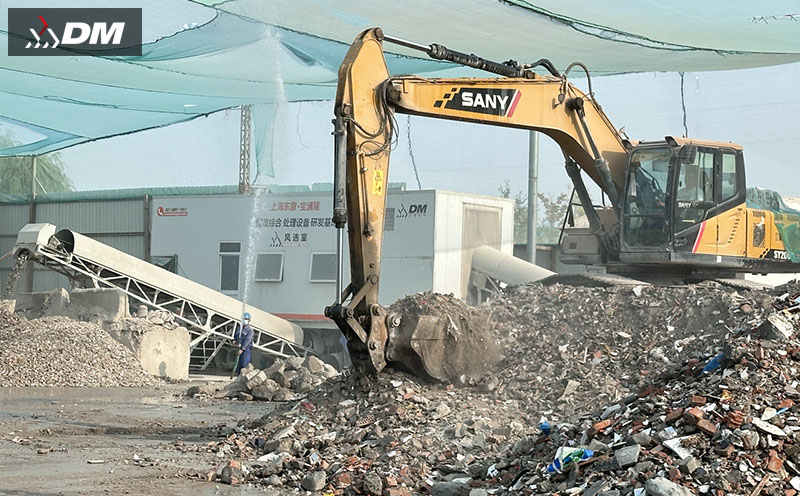
The pretreatment link focuses on "reduction": for impurities such as steel bars, wood, and plastic in construction solid waste, a combination of manual sorting and mechanical pretreatment is adopted to first remove large impurities and cut entanglements, reducing the difficulty of subsequent crushing and equipment wear; for toxic and harmful substances in industrial waste residue (such as heavy metals in smelting slag and corrosive components in chemical waste residue), chemical stabilization treatment or physical isolation pretreatment is carried out to reduce the pressure of harmless treatment and avoid secondary pollution. The crushing link adopts graded crushing technology, and equipment is flexibly configured according to solid waste types and recycling needs: tracked mobile crushing stations are selected for construction solid waste, which can operate on-site to reduce transportation pollution. Equipped with jaw primary crushing modules and impact tertiary crushing modules, concrete blocks, masonry, and other materials are crushed into 3-31.5mm recycled aggregates with a crushing ratio of 1:25 and a volume reduction rate of over 80%; fixed crushing production lines are used for industrial waste residue (such as gangue and slag), and cone crushing modules are configured to improve wear resistance, adapting to high-hardness and high-abrasiveness materials, ensuring crushing efficiency and finished product quality.
Precise sorting and core resource utilization links: equipped with a multi-dimensional sorting system of "magnetic separation + air separation + infrared identification + screening", the high-strength magnetic separation device can efficiently separate waste steel bars in construction solid waste with a recovery rate of over 98%, and the sorted steel bars can be remelted; the air separation device separates light plastic, wood chips, and heavy aggregates according to the difference in material specific gravity, with a purity of 95%; the infrared identification system can accurately identify non-metallic impurities of different materials, realizing directional sorting of plastic, rubber, and other materials, providing guarantee for subsequent special recycling; multi-stage vibrating screens classify recycled aggregates into different specifications according to particle size differences to meet diverse recycling needs. Harmless treatment technology has been upgraded simultaneously: for toxic and harmful solid waste (such as medical waste and chemical hazardous waste), high-temperature pyrolysis, chemical neutralization, microwave disinfection, and other technologies are adopted to completely decompose harmful substances, ensuring that the residue after treatment meets environmental discharge standards; for the final residue disposed of by landfilling, anti-seepage liners and leachate collection and treatment systems are adopted to prevent pollutant leakage and realize a closed-loop of "harmlessness".
Diversified Recycling Paths: Turning Solid Waste into "Green Resources" to Respond to the Resource Recycling Trend
The core value of solid waste treatment solutions lies in "resource utilization". Through technological optimization, the quality upgrade and application expansion of recycled products are realized, making waste a "green raw material" to replace natural resources, which not only alleviates the pressure of resource shortage but also creates considerable economic value.
The recycling of construction solid waste is the most mature: after crushing and sorting, the recycled aggregates can replace natural sand and gravel for producing recycled concrete, masonry mortar, road base materials, etc., after strengthening treatment. Among them, recycled aggregates with a particle size of 10-20mm have been widely used in urban road and square pavement projects, with a cost 30% lower than natural sand and gravel, and indicators such as compressive strength and wear resistance meet the GB/T 25177-2010 standard; fine-grained recycled aggregates (3-5mm) can be processed into new building materials such as permeable bricks, slope protection bricks, and ecological floor tiles, which have excellent water permeability and air permeability, meeting the needs of sponge city construction, and market recognition continues to improve; the separated waste steel bars and iron wires can be directly sold to steel enterprises for recycling after simple treatment. A production line processing 100,000 tons of construction solid waste per year can recover about 3,000 tons of waste steel, creating additional income.
The recycling paths of industrial solid waste are constantly expanding: gangue can be used for producing sintered bricks, roadbed fillers, or as power generation fuel after crushing and screening, realizing the dual benefits of "solid waste emission reduction + energy recovery"; industrial waste residues such as slag and steel slag can be processed into slag powder as a cement admixture, which not only improves cement strength but also reduces carbon emissions in cement production. Each ton of slag powder can replace 40% of cement clinker and reduce carbon dioxide emissions by about 0.8 tons; agricultural solid waste (such as crop straw and livestock manure) is processed into biomass fuel and organic fertilizer through fermentation, realizing "turning waste into fertilizer" and helping the green circular development of agriculture. After sorting, urban domestic waste can recover renewable resources such as plastic, paper, and metal. Kitchen waste produces biogas for power generation through anaerobic fermentation, and the slag after incineration power generation can be processed into recycled aggregates, realizing "full utilization of garbage".
Strengthened Environmental Performance: Fully Adapting to the Trend of Strict Environmental Policies
Current environmental protection policies have put forward unprecedented strict requirements for dust, noise, sewage, and waste gas emissions from solid waste treatment. Advanced solid waste treatment solutions achieve full-process environmental compliance through the integration of environmental protection technologies and equipment upgrades, helping enterprises avoid policy risks.
Precise control of dust pollution: the crushing, screening, conveying, and other links adopt a fully sealed design. The equipment body and conveyor belt are equipped with sealed covers to reduce dust leakage; combined with pulse bag filters or electrostatic precipitators, the dust treatment efficiency is over 99.5%, and the emission concentration is ≤5mg/m³, far lower than the national limit of 10mg/m³; some mobile equipment is equipped with spray dust suppression systems to further suppress dust through atomized water spraying, which can operate around residential areas and urban core areas without affecting the environment. Effective control of noise pollution: the equipment adopts low-noise motors and shock-absorbing bases, and the internal optimization design of the crushing cavity reduces material impact noise. Combined with sound insulation covers and mufflers, the operating noise is controlled within 75 decibels, meeting the environmental noise emission standards for industrial enterprise boundaries; the tracked chassis of mobile equipment can reduce the conduction of site vibration and reduce the impact on the surrounding environment.
Harmless treatment of sewage and waste gas: the wastewater generated from solid waste cleaning and dust reduction is recycled after sedimentation, filtration, and purification treatment, realizing "zero discharge" and avoiding groundwater pollution by sewage; for the waste gas generated from incineration and pyrolysis links, a multi-stage treatment process of "desulfurization + denitrification + dust removal + activated carbon adsorption" is adopted to remove harmful substances such as sulfur dioxide, nitrogen oxides, and dioxins, ensuring that the waste gas emission meets the standards; the waste liquid generated during chemical treatment is collected and handed over to professional institutions for treatment to prevent arbitrary discharge. In addition, solid waste treatment solutions also focus on carbon emission reduction design. Some equipment supports electric drive mode, replacing traditional diesel engines with zero exhaust emissions; the production and mining links of recycled products replacing natural resources can indirectly reduce carbon emissions, helping enterprises achieve carbon emission reduction goals.
Scenario-Based Adaptation: Empowering Multiple Industries to Respond to the Green Development Trend
Through modular design and technical customization, solid waste treatment solutions can be flexibly adapted to multiple industry scenarios such as construction, mining, chemical industry, and urban governance, becoming the "standard equipment" for various fields to respond to the trends of environmental protection and resource recycling.
Construction industry: for demolition sites and construction waste disposal yards, mobile integrated crushing and sorting equipment is configured to realize "on-site treatment and nearby utilization", reducing environmental pollution and costs during transportation. After adopting this solution in a city demolition project, the resource utilization rate of construction solid waste reached 95%, saving over 200,000 tons of natural sand and gravel mining annually; mining industry: processing mining waste rock and mineral processing tailings into manufactured sand and roadbed aggregates, realizing "mining solid waste not leaving the site", which not only solves the environmental problem of waste rock accumulation but also supplements the raw material supply of mining enterprises and reduces procurement costs; chemical industry: adopting a combined solution of "harmless treatment + resource recovery" for hazardous waste, such as the recovery of precious metals from waste catalysts and the neutralization and regeneration of waste acids and alkalis, which not only meets the environmental requirements for hazardous waste treatment but also realizes the recycling of precious metals and chemical raw materials; urban governance field: configuring large-scale comprehensive solid waste treatment centers integrating sorting, recycling, incineration power generation, and other functions to handle urban domestic waste and decoration waste. After adopting this solution in a prefecture-level city, the urban solid waste landfill volume was reduced by 70%, and the annual power generation capacity reached 120 million kilowatt-hours, realizing a win-win situation of environmental protection and energy recovery.
Under the dual trends of increasingly strict environmental protection policies and the deepening of resource recycling concepts, solid waste treatment solutions are no longer just "environmental supporting facilities", but have become the core support for enterprises to reduce costs, improve efficiency, and enhance competitiveness, and even the key path for society to achieve sustainable development. In the future, with the continuous integration of intelligent and green technologies, solid waste treatment solutions will upgrade towards the direction of "higher resource utilization rate, lower energy consumption, and more precise environmental control". Through technological innovations such as AI intelligent sorting, big data operation and maintenance, and new energy drive, the resource value of solid waste will be further explored, helping more industries break through environmental and resource bottlenecks. While protecting the ecological environment, it will realize the coordinated win-win of economic development and social benefits, making "recycling" the mainstream model of global green development.
If you would like to get help immediately, you can also fill your requirements on the following form, we will contact you on the right time.


Get In Touch