







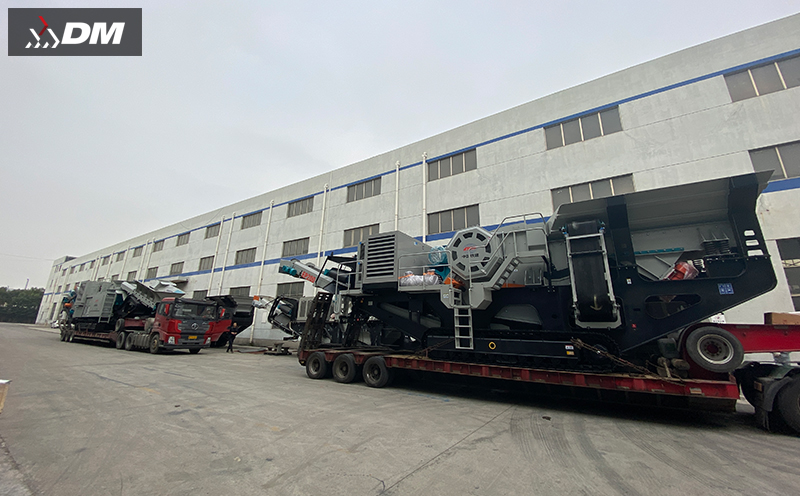
In fields such as infrastructure construction, urban renewal, and emergency disaster relief, short-term projects (usually with a construction period of 1-6 months) account for a significant proportion. Such projects are generally characterized by "tight construction schedules, scattered operation locations, diverse material types, flexible capacity requirements, and limited site conditions". For example, rural road emergency repairs need to complete aggregate processing before the rainy season, urban demolition projects need to quickly handle construction waste to avoid accumulation, and emergency disaster relief requires urgent provision of building materials to support post-disaster reconstruction. Traditional fixed equipment has shortcomings such as "long installation cycles, difficult relocation, and poor adaptability", while small temporary equipment faces problems of "insufficient capacity and lack of stability", making it difficult to meet the core demands of short-term projects for "rapid response, flexible adaptation, and efficient completion". With core advantages of "rapid deployment, flexible relocation, immediate production upon arrival, and on-demand configuration", mobile solutions accurately address the multiple pain points of short-term projects through integrated design and all-terrain adaptability, becoming a "flexible combat unit" supporting the efficient progress of projects.
Rapid Deployment + Immediate Production: Solving the "Tight Schedule" Pain Point of Short-Term Projects
The core demand of short-term projects is "racing against time and meeting deadlines". Through optimized design, mobile solutions minimize the "installation and commissioning cycle" to achieve "production immediately upon equipment arrival", significantly shortening project preparation time.
Integrated design eliminates cumbersome installation: Mobile equipment highly integrates core systems such as crushing, screening, conveying, power, and control on a tracked or wheeled chassis, eliminating the need for split transportation and on-site assembly. Adopting a foundation-free design, the equipment does not require complex civil engineering. After arriving at the operation site, the operator only needs 30 minutes to 2 hours to complete simple steps such as equipment unlocking, outrigger fixing, and parameter calibration, and start operation directly. Compared with the "1-2 week" installation and commissioning cycle of traditional fixed equipment, the commissioning efficiency of mobile solutions is increased by more than 80%, perfectly adapting to time-sensitive short-term projects such as road emergency repairs and emergency disaster relief. For example, sudden heavy rains caused a national highway slope collapse in a certain area. Using a mobile crushing station, it only took 4 hours from dispatch to on-site aggregate production, and the road backfilling and restoration were completed on the same day, saving 3 days of construction period compared with the traditional plan.
Flexible power configuration gets rid of external dependence: The equipment can be equipped with a high-power diesel engine to support independent and continuous operation without external power supply, perfectly adapting to short-term operations in remote areas without electricity; some models support the "oil-electric dual-purpose" mode, which can switch to electric drive in scenarios with power supply such as urban areas, reducing energy consumption and operating costs. In addition, the equipment is equipped with a one-key start-stop intelligent control system with a simple and intuitive operation interface and illustrated operation guides. Ordinary operators can get started after simple training, further shortening the commissioning preparation time and ensuring the rapid progress of the project.
Flexible Relocation + All-Terrain Adaptability: Adapting to the "Multi-Scenario" Needs of Short-Term Projects
Short-term projects often face the challenge of "multiple operation locations and complex site conditions". For example, urban demolition projects may involve multiple scattered demolition sites, and rural infrastructure projects need to switch operations between different villages. With excellent relocation capabilities and all-terrain adaptability, mobile solutions can "complete work at one location and immediately move to the next".
Tracked mobile equipment is equipped with an all-terrain track system. High-strength wear-resistant rubber tracks have low ground contact pressure, enabling stable driving on muddy and soft roads without getting stuck; the minimum turning radius is only about 3 meters, which can flexibly shuttle in narrow lanes and demolition sites, adapting to space-constrained scenarios; the climbing capacity can reach 30°, which can easily cope with inclined operation sites such as mountains and slopes, and can quickly take position without leveling the site. Wheeled mobile equipment is suitable for scenarios with good road conditions, with a driving speed of up to 60km/h, which can be quickly transported through ordinary highways, increasing relocation efficiency by 50%. For remote scenarios without transportation roads, some small mobile equipment can be disassembled into core modules, transported by small trucks or helicopters, and quickly assembled for production on site, completely solving the problem of "difficult access".
Multi-scenario rapid switching capability: The equipment adopts a modular design, and the crushing module can be quickly replaced according to the project material characteristics—when processing construction waste such as concrete blocks and masonry, it is equipped with jaw + impact crushing modules; when processing hard rocks such as granite and iron ore, it is switched to jaw + cone crushing modules; when processing loose materials such as soil and gangue, an integrated screening + impact crushing module is selected. In addition, the screen mesh aperture of the screening module can be quickly replaced (3-31.5mm), which can accurately produce finished products of different specifications, meeting diverse needs such as road bases, concrete mixing, and brick making, realizing "one set of equipment adapting to multiple types of projects".
On-Demand Configuration + Efficient Stability: Matching the "Flexible Capacity" Demand of Short-Term Projects
The capacity demand of short-term projects is "flexible". For example, small rural road construction requires 300-500 tons of aggregates per day, while large-scale temporary demolition projects may need to process more than 1,000 tons of construction waste per day. Through a wide range of model options and efficient operation performance, mobile solutions accurately match the capacity needs of short-term projects of different scales.
Full-range capacity coverage: The processing capacity of mobile equipment ranges from 30 tons to 500 tons per hour, which can be flexibly selected according to the project scale—small models (30-100 tons/hour) are suitable for short-term projects such as rural roads and small-scale demolition; medium models (100-300 tons/hour) meet medium-scale needs such as municipal renovation and emergency disaster relief; large models (300-500 tons/hour) can cope with large-scale short-term projects such as large-scale demolition and temporary aggregate processing yards. Some equipment supports multi-machine joint operation. When the capacity of a single device is insufficient, multiple devices can be quickly deployed to work together to form a temporary production line, with capacity expanded on demand without overall upgrading.
Efficient stability guarantees project progress: Although it is short-term operation, mobile solutions still maintain high-standard operational stability. Core components of the equipment are selected from internationally renowned brands, verified by harsh working conditions, with a mean time between failures of more than 800 hours; wear-resistant parts are made of high-chromium alloy material, with a service life extended by 30%, reducing the frequency of shutdown maintenance in short-term projects. The intelligent control system can real-time monitor equipment operating parameters, automatically adjust the crushing gap and screening frequency according to material characteristics, ensuring stable discharge quality and avoiding construction delays caused by unqualified products. In an old urban area demolition project in a certain city, 3 mobile crushing stations operated in conjunction, processing 1,200 tons of construction waste per day, running continuously for 2 months without major failures, ensuring the project completed the demolition waste treatment on schedule.
Low Cost + Easy Operation and Maintenance: Reducing the "Investment Pressure" of Short-Term Projects
Short-term projects generally focus on "input-output ratio" and are sensitive to equipment procurement and operation and maintenance costs. Through full-life cycle cost optimization, mobile solutions achieve "low-cost and high-efficiency" operations, reducing project capital pressure.
More economical initial investment: Compared with the large civil engineering and equipment procurement costs of fixed production lines, mobile solutions do not require infrastructure investment, and equipment can be leased or purchased in installments, significantly reducing initial capital occupation; no disassembly and reconstruction are required during relocation, saving transportation and installation costs. For multi-location short-term projects, the comprehensive cost is reduced by more than 40%. Controllable operation and maintenance costs: The equipment has a simple structure, with few types of vulnerable parts and high generalization, resulting in low procurement and replacement costs; it is equipped with remote diagnosis functions, allowing professional engineers to remotely troubleshoot faults through the system and guide on-site personnel to handle them quickly, reducing maintenance waiting time and labor costs; fuel consumption is optimized, reducing by 15%-20% compared with traditional equipment, further controlling operating costs.
Environmental compliance without worries: Mobile solutions adopt a fully sealed crushing cavity and screening system, combined with a pulse dust removal device, with a dust emission of ≤10mg/m³, meeting environmental standards; the noise reduction structure is optimized, and the operating noise is controlled within 75 decibels, which can operate around residential areas without affecting residents' lives, avoiding project shutdowns caused by environmental issues and ensuring the smooth progress of short-term projects.
From emergency response in disaster relief to flexible operations in urban renewal, from efficient progress in rural infrastructure to rapid commissioning of temporary aggregate yards, mobile solutions have become the ideal choice for short-term projects with core advantages of "rapidity, flexibility, efficiency, and low cost". They not only solve the pain points of traditional equipment such as "poor adaptability, slow commissioning, and high cost" but also can flexibly adjust according to the dynamic needs of projects, helping enterprises complete operational goals with high quality within limited construction periods. In the future, with the continuous upgrading of intelligent and green technologies, mobile solutions will further achieve "smarter scheduling, more efficient operation, and more environmentally friendly work", providing strong equipment support for more short-term projects and becoming the core force of "flexible combat" in the infrastructure and environmental protection fields.
If you would like to get help immediately, you can also fill your requirements on the following form, we will contact you on the right time.


Get In Touch